Can You Shower With Gold Plated Jewellery? What Australians Need to Know
Most women want to know one thing before they buy jewellery online in Australia. Can I wear this in the shower? The honest answer depends entirely on what the piece is made from. This guide explains which materials handle daily water exposure, why most gold plated jewellery cannot be worn in the shower, and why 18K PVD gold plated stainless steel is built for exactly that.
It depends on the material. Standard gold plated jewellery on a brass or copper base should not be worn in the shower. 18K PVD gold plated stainless steel is designed for daily water exposure and can be worn in the shower every day.
Why the Answer Depends on the Material
Not all gold plated jewellery is made the same way. The phrase gold plated covers a wide range of products at different price points and quality levels. Understanding the difference is the key to knowing whether a piece can go in the shower or not.
At one end of the spectrum is standard gold plated jewellery. This uses a process called electroplating, where a very thin layer of gold is deposited onto a base metal, usually brass or copper. The gold layer is often less than half a micron thick. It looks beautiful when it is new but it is fragile. Water, sweat, soap and daily wear all break down that thin layer relatively quickly. Once it goes, the base metal underneath oxidises and the piece tarnishes, discolours or leaves green marks on your skin.
At the other end is 18K PVD gold plated stainless steel. PVD stands for Physical Vapour Deposition. It is a vacuum-based coating process where real 18K gold is vaporised and bonded to a stainless steel base at a molecular level. The result is a coating that is considerably harder and more durable than electroplating, resistant to water, and built to handle daily life including showers, sweaty workouts and beach days.
The difference between standard gold plating and 18K PVD gold plating is not just about appearance. It is about what happens to the piece three months, six months and two years after you first put it on.
What Happens When You Shower in Standard Gold Plated Jewellery
Many women do shower in their jewellery without thinking about it, and the damage is not always immediately visible. What happens is gradual. Each shower removes a small amount of the gold layer. The soap and hot water soften and loosen the bond between the gold and the base metal beneath. After enough exposure, the layer begins to wear thin at the points of most friction, usually the back of a ring band, the clasp of a necklace or the inner face of a bracelet.
Once the base metal is exposed, the oxidisation begins. Brass turns green. Copper discolours. The piece that looked perfect in the box starts to look dull and patchy. None of this is reversible. The only solution is to replace the piece.
The speed at which this happens varies depending on how thick the original plating was. Standard electroplating is typically between 0.3 and 0.5 microns thick. Some very cheap pieces are even thinner. At that thickness, regular showering can cause visible wear within weeks or months.
Why 18K PVD Gold Plated Stainless Steel Is Different
The stainless steel base is the first thing that makes the difference. Stainless steel contains chromium, which forms a protective oxide layer on the surface that actively prevents corrosion. Unlike brass or copper, stainless steel does not react to water. It does not rust. It does not oxidise when the gold layer wears. This is why stainless steel surgical tools and kitchen equipment last for decades without deteriorating.
The PVD coating adds to this. Instead of depositing a thin layer of gold on top of the surface using an electrical current, PVD vaporises the gold and bonds it to the stainless steel at a molecular level. The result is a coating that is typically one to two microns thick, significantly more durable than standard electroplating, harder and more resistant to water, sweat and everyday friction.
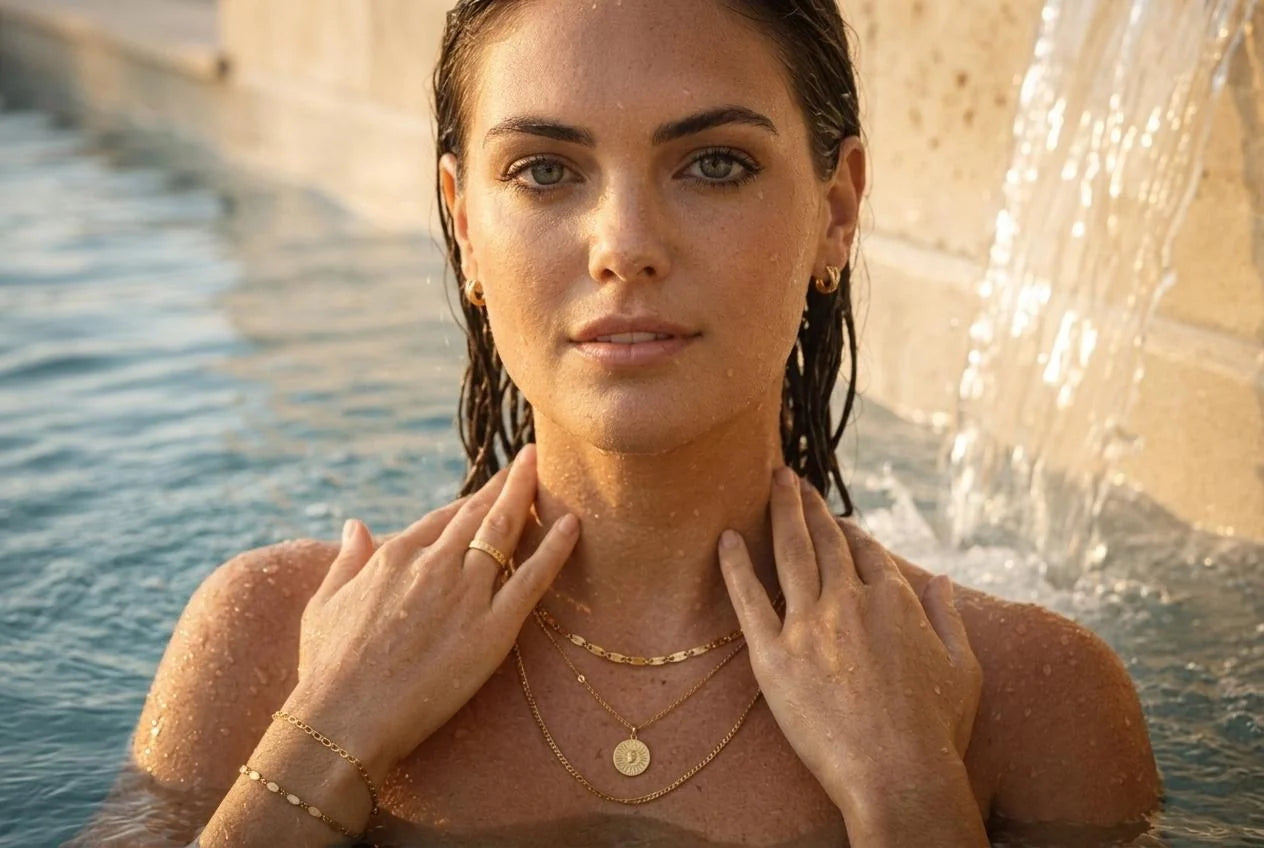
All GLISTIA pieces are made from 18K PVD gold plated stainless steel. You can shower in them every day. The material is built for it.
| Material | Safe to Shower In? | What Happens With Water |
|---|---|---|
| 18K PVD Stainless Steel | Yes | No reaction. Waterproof finish holds. |
| Solid Stainless Steel | Yes | No reaction. Fully corrosion resistant. |
| Solid Gold (9K to 18K) | Yes | No reaction. Gold does not corrode. |
| Sterling Silver 925 | No | Tarnishes with regular water exposure. |
| Gold Vermeil | No | Gold layer breaks down. Base tarnishes. |
| Standard Gold Plated on Brass | No | Layer wears quickly. Brass oxidises and turns green. |
| Gold Filled | With care | More durable than plated but still not fully waterproof. |
Every piece in the GLISTIA waterproof collection is made from 18K PVD gold plated stainless steel. Shower in it. Swim in it. Wear it every day.
Shop Waterproof JewelleryDoes Shampoo or Conditioner Damage Jewellery?
This is a question that comes up a lot, and the honest answer is that it depends on both the product and the material.
For 18K PVD gold plated stainless steel, shampoo and conditioner do not damage the piece. They can leave a residue over time that makes the surface look slightly dull, but this is easily removed with a wipe of a soft cloth. The materials themselves are not reactive to the ingredients in most haircare products.
For standard gold plated jewellery on a brass base, shampoo and conditioner add to the problem that water already creates. The combination of moisture and chemical residue accelerates the breakdown of the thin gold layer. If you are wearing standard gold plated jewellery and determined to shower in it, removing any product residue immediately afterwards gives it the best chance of lasting longer, but it will still deteriorate over time.
Perfume and aerosol hairspray are worth a separate mention. Both can affect almost any jewellery surface including stainless steel. The alcohol in perfume and the propellants in aerosols can dull the finish on any piece over time. The simple habit of putting jewellery on after applying perfume and letting hairspray dry before putting on earrings avoids this entirely.
How to Care for 18K PVD Gold Plated Jewellery in the Shower
The care requirements for GLISTIA pieces are genuinely minimal. Here is what is worth knowing.
What About Hot Showers?
Hot water does not damage 18K PVD gold plated stainless steel. The stainless steel base and the PVD coating are both rated for temperatures well above what a standard shower produces. Steam and hot water do not affect the material.
Where heat can become a consideration is in situations like saunas or steam rooms where temperatures are significantly higher and sustained for longer periods. If you wear your jewellery in a sauna regularly, a wipe with a soft cloth afterwards is a sensible habit. The material handles it, but any residue from skin products sitting in prolonged heat is worth removing.
Can You Sleep in 18K PVD Gold Plated Jewellery?
Yes, for most pieces. The material does not react with skin overnight and will not tarnish or discolour from body heat or night sweats. The main practical consideration is comfort and potential tangling for necklaces and bracelets. Fine chain necklaces can tangle during sleep. If you prefer to take them off overnight, storing them in your GLISTIA box keeps them in good condition. If you prefer to leave them on, the material handles it.
For earrings and rings, there is no material reason to remove them overnight. Many women find it more practical to leave them on rather than risk losing them or forgetting to put them back on in the morning.
Is 18K PVD Gold Plated Jewellery Also Safe for Swimming?
Yes. 18K PVD gold plated stainless steel handles both ocean and pool water well. Saltwater does not corrode stainless steel. Chlorinated pool water is equally handled by the material. The one habit worth building is rinsing pieces with fresh water after swimming in the ocean or a chlorinated pool. This removes mineral deposits and chlorine residue from the surface, which over long periods of time can leave a film on any jewellery if not rinsed off.
For a more detailed look at wearing jewellery in the ocean and pool, see our guide on wearing jewellery in the ocean in Australia. And for a comprehensive overview of all things waterproof, the complete guide to waterproof jewellery in Australia covers everything in one place.
How Do You Know If Your Current Jewellery Is Shower Safe?
The quickest way is to check what the base metal is. If a product description does not specify the base metal, that is usually a sign it is brass or copper, and the piece should not be worn in the shower.
If the description says stainless steel or surgical steel, and the plating method is specified as PVD rather than just gold plated, the piece is shower safe. If it says gold plated without specifying the method, treat it as standard electroplating and keep it out of the shower.
All GLISTIA pieces include the full material description. 18K PVD gold plated stainless steel. That tells you exactly what the base metal is, what the plating method is, and what the gold content is. No guessing required. Browse the full 18K PVD gold plated collection or the waterproof jewellery collection to see everything available.
Jewellery you can shower in, swim in and wear every day. 18K PVD gold plated stainless steel. Free shipping on qualifying Australian orders.
Shop Waterproof JewelleryAbout GLISTIA
GLISTIA is a Sydney-based jewellery brand making premium 18K PVD gold plated stainless steel jewellery for Australian women. Every piece in the range is waterproof, tarnish resistant and designed for daily wear. Shower in it, swim in it, wear it to the gym. No removing. No worrying.
The range covers gold plated earrings, gold plated necklaces, gold plated bracelets and bangles, gold plated rings and gold plated anklets. All dispatched from Sydney with free shipping on qualifying Australian orders.
Free shipping on qualifying Australian orders. 30-day returns. Dispatched from Sydney, NSW.
Shop the Waterproof CollectionFrequently Asked Questions
Can you shower with gold plated jewellery?
It depends on the type of plating. Standard gold plated jewellery on a brass or copper base should not be worn in the shower because water and soap break down the thin gold layer and cause the base metal to tarnish. 18K PVD gold plated stainless steel is different. It is designed for daily water exposure and can be worn in the shower every day.
Can you shower with 18K PVD gold plated jewellery?
Yes. 18K PVD gold plated stainless steel jewellery is built for daily water exposure. The stainless steel base does not corrode or react to water, and the PVD coating is significantly more durable and waterproof than standard electroplated gold. You can shower in it every day without it tarnishing or losing its finish.
What happens if you shower with regular gold plated jewellery?
Showering regularly in standard gold plated jewellery causes the gold layer to wear away faster than normal. Once the layer breaks down, the base metal underneath, usually brass or copper, is exposed. This causes tarnishing, discolouration and in some cases green marks on the skin. The damage is not reversible.
Does shampoo and conditioner damage gold plated jewellery?
For 18K PVD gold plated stainless steel, shampoo and conditioner do not cause damage. They can leave a light residue over time which a soft cloth removes easily. For standard gold plated jewellery on a brass base, the combination of water and product residue accelerates the breakdown of the gold layer.
What jewellery can I wear in the shower every day in Australia?
The most reliable options for daily shower wear are solid gold, solid platinum, stainless steel and 18K PVD gold plated stainless steel. Of these, 18K PVD gold plated stainless steel is the most accessible in terms of price and offers the same waterproof performance as more expensive materials for everyday wear.
Can I swim in 18K PVD gold plated jewellery?
Yes. 18K PVD gold plated stainless steel handles both ocean and pool water well. Rinse pieces with fresh water after swimming in saltwater or chlorinated pools to remove any mineral residue and keep the finish looking its best over time.