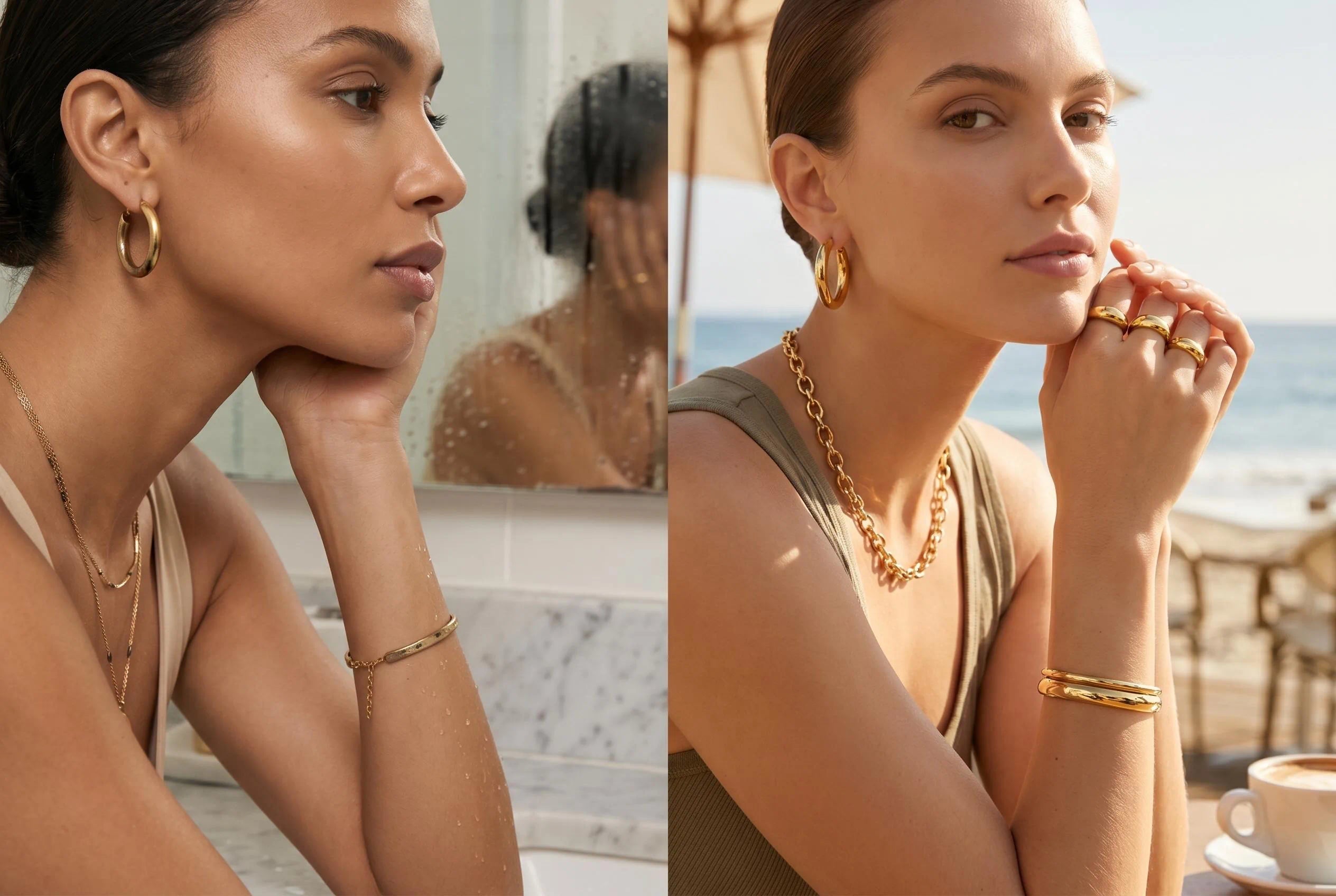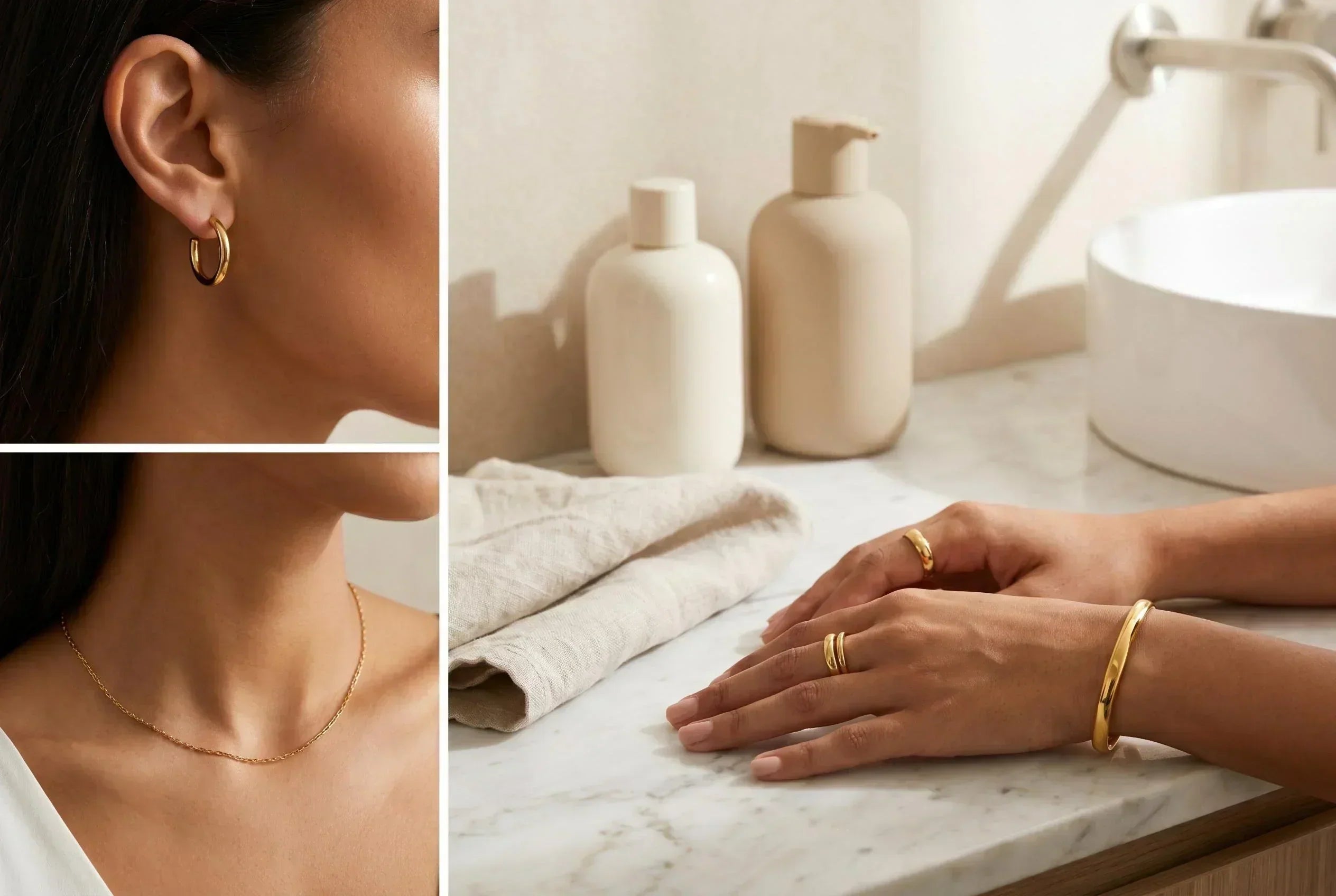
What hypoallergenic really means, why nickel is the problem most people do not know about, and what actually makes a piece of jewellery safe for sensitive skin in Australia.
If your ears itch after wearing earrings, your wrists break out in a rash or your rings leave red marks on your fingers, the jewellery is not the problem. The metal inside it is. And the good news is that once you know what to look for, it is completely avoidable.
PVD gold plating on a stainless steel base is one of the most skin friendly jewellery options available in Australia right now. But before we explain why, it helps to understand what is actually causing reactions in the first place, and what the word hypoallergenic really means when you see it on a product description.
Because it does not mean what most people think it does.
What Hypoallergenic Actually Means
The word hypoallergenic means that a product is less likely to cause an allergic reaction. Less likely. Not guaranteed to be reaction free for every single person. There is no universal standard in Australia that certifies a piece of jewellery as officially hypoallergenic. Any brand can use the term, which is why it pays to look past the label and understand the actual materials instead.
What matters is what the piece is made of. Specifically, whether the base metal contains nickel, whether the plating is thick and stable enough to prevent the base metal from touching your skin, and whether the overall construction holds up under the conditions you actually wear it in.
Under Australian Consumer Law, product claims must be accurate and not misleading. If a piece of jewellery is described as hypoallergenic, it must genuinely be less likely to cause a reaction. If you experience a skin reaction from a piece described this way, you have grounds to raise it with the retailer.
Why Nickel Is the Real Problem
Nickel is the most common cause of contact dermatitis from jewellery. It is a metal that is added to cheap alloys because it is inexpensive, adds hardness and produces a shiny finish. The problem is that nickel leaches through the skin when it comes into contact with sweat and moisture. For people with a nickel sensitivity, this triggers an immune response. Redness, itching, swelling and rashes are all typical reactions.
Nickel allergies are significantly more common in women than men, largely because of how frequently women wear earrings from an early age. The more exposure, the more likely a sensitivity develops over time. Some women find their tolerance decreases as they get older, meaning pieces they wore comfortably at 20 start causing reactions at 35.
The frustrating part is that nickel is hidden in many pieces that look perfectly fine from the outside. It can be in the base metal under a gold plating. It can be in the alloy of a piece labelled as gold. It can be in the earring post even if the rest of the piece is nickel free. Location matters as much as quantity.
Earrings are the highest risk category for nickel reactions because the metal is in direct contact with tissue that has been pierced. Earrings, particularly stud earrings and hoop earrings, should only be worn with pieces that are confirmed to be nickel free if you have any history of reactions.
Why Traditional Gold Plating Can Still Cause Reactions
Here is where a lot of people get caught out. They buy something described as gold jewellery, assume gold means safe, and still end up with a reaction. The gold is rarely the problem. What is underneath it is.
Traditional gold plating typically uses brass or copper as the base metal. To help the gold bond to these metals, a layer of nickel is often used as an intermediate coating. So the construction is: brass or copper base, then a nickel bonding layer, then gold on top. When the thin gold plating wears away, which it does fairly quickly with regular wear, the nickel layer becomes exposed directly against your skin.
This is exactly why people have good experiences with a piece for the first few weeks and then start reacting to it. The gold plating has worn thin in the spots with the most contact and the nickel underneath is now touching the skin.
The gold you can see is not what touches your skin. It is what is underneath that determines whether your skin reacts.
Why PVD Gold Plating on Stainless Steel Is Different
PVD gold plating on stainless steel changes the equation on two fronts.
First, the base metal. Stainless steel, specifically 316L surgical grade stainless steel, is one of the most chemically stable metals used in any kind of consumer product. It is the same material used in surgical instruments and implants. It does not react with moisture, sweat or skin chemistry. It does not corrode. And quality stainless steel used in jewellery contains no nickel in a form that can leach through the skin, which means the base metal itself poses minimal risk for most people.
Second, the plating process itself. As we covered in our guide to PVD vs traditional gold plating, PVD plating bonds gold to the surface at a molecular level inside a vacuum chamber. There is no nickel bonding layer in between. The gold bonds directly to the stainless steel. The coating is also significantly harder and more wear resistant than electroplated alternatives, which means the stainless steel base stays protected for longer during regular wear.
The result is a piece of 18K PVD gold plated jewellery that, when made to quality standards, contains no nickel in contact with skin and uses a non reactive base metal. This makes it generally suitable for most skin types, including people who have reacted to fashion jewellery in the past.
A note on the word generally
We use the word generally because no metal is suitable for every single person in every circumstance. A very small number of people have sensitivities to specific components of stainless steel itself, and individuals with severe known metal allergies should always confirm materials with any brand before purchasing and consult a dermatologist if they have concerns. What we can say is that 18K PVD gold on 316L stainless steel is, by construction, free of the most common causes of jewellery reactions.
How Different Metals Compare for Sensitive Skin
What to Check Before You Buy
Reading a product listing carefully before purchasing makes a significant difference if you have sensitive skin. These are the specific things worth checking every time.
Stainless steel is the best option for sensitive skin. If the listing says brass, copper or does not mention the base metal at all, treat that as a yellow flag. Ask the brand directly if the information is not clear.
A brand confident in its materials will state clearly that the piece is nickel free. If the listing only says hypoallergenic without specifying materials, ask what that means in practice for that specific piece.
18K gold can be applied through electroplating with a nickel bonding layer, or through PVD without one. Both are 18K gold. But only one is free of nickel throughout the construction. Ask which process was used.
The post is the part that goes through the piercing and has the most direct, prolonged contact with tissue. Even if the front of an earring is safe, a containing nickel post can cause reactions. Confirm posts are stainless steel or titanium specifically.
Even with a piece that should be safe, wearing it for a few hours the first time rather than all day gives you a chance to see how your skin responds before committing to extended wear. Most reactions show within a few hours of contact.
Every piece across the waterproof jewellery collection uses 18K PVD gold plating over 316L surgical grade stainless steel. The base metal, plating process and nickel free construction are stated on every product page. That transparency is the standard we hold ourselves to across all earrings, necklaces, rings, wristwear and anklets in the range.
A Quick Word on Reactions That Are Not Allergies
Not every skin reaction to jewellery is an allergy. Sometimes the issue is simply oxidation. Copper and brass jewellery oxidise when they come into contact with moisture and the acids on your skin, leaving green marks behind. This is not a medical reaction. It is a chemical one. The green is copper carbonate forming on the surface of the metal. It washes off and causes no harm, but it is not what anyone wants on their skin.
This is another reason the base metal matters so much. Stainless steel does not oxidise. It does not turn your skin green. And because quality PVD gold plated jewellery uses stainless steel as the base, both the green mark problem and the nickel reaction problem are addressed through the same material choice.
For sterling silver rings and silver based pieces, a small amount of tarnishing is normal over time, but this is surface oxidation of the silver itself rather than a skin reaction. Regular cleaning keeps silver pieces looking their best and prevents any build up on the skin contact surfaces.
18K PVD gold plating on 316L stainless steel is generally considered suitable for most skin types, including those with a history of reactions to fashion jewellery. The stainless steel base is nickel free in quality pieces, and the PVD process bonds gold directly without a nickel intermediate layer. Individuals with severe known metal allergies should consult a dermatologist before wearing any metal jewellery.
The most common cause is nickel, which is widely used in fashion jewellery alloys and as a bonding layer under gold plating. When nickel contacts skin, particularly skin that is sweating or moist, it leaches through and triggers an immune response in people with a sensitivity. Redness, itching, swelling and rashes are typical symptoms. Choosing nickel free pieces with stable base metals like stainless steel is the most effective way to prevent this.
Yes, if the earrings are made with 18K PVD gold plating on a stainless steel base and the posts are confirmed nickel free. The key is the construction underneath the gold. Traditional gold plating on brass with a nickel bonding layer is a common cause of earring reactions. PVD gold on stainless steel removes both of those risk factors, making it a much safer option for people with sensitive ears.
No. Hypoallergenic means less likely to cause a reaction, not reaction free for every person. There is no universal Australian certification for hypoallergenic jewellery. The term is widely used and can mean different things from different brands. The most reliable approach is to check the specific materials rather than rely on the label alone. Confirm the base metal, confirm nickel free construction, and confirm the plating process used.
This happens most commonly with traditionally plated pieces. The gold plating wears away over time, exposing a nickel bonding layer underneath. Once that layer is in direct contact with skin, reactions begin. The piece was fine before because the gold was intact. Metal sensitivities can also develop over time with repeated exposure. Switching to PVD gold plating on stainless steel, which has no nickel bonding layer and a more durable coating, addresses the root cause of this pattern.
Jewellery Designed to Work With Your Skin
18K PVD gold on surgical grade stainless steel. Nickel free. Designed for everyday wear in Australia.