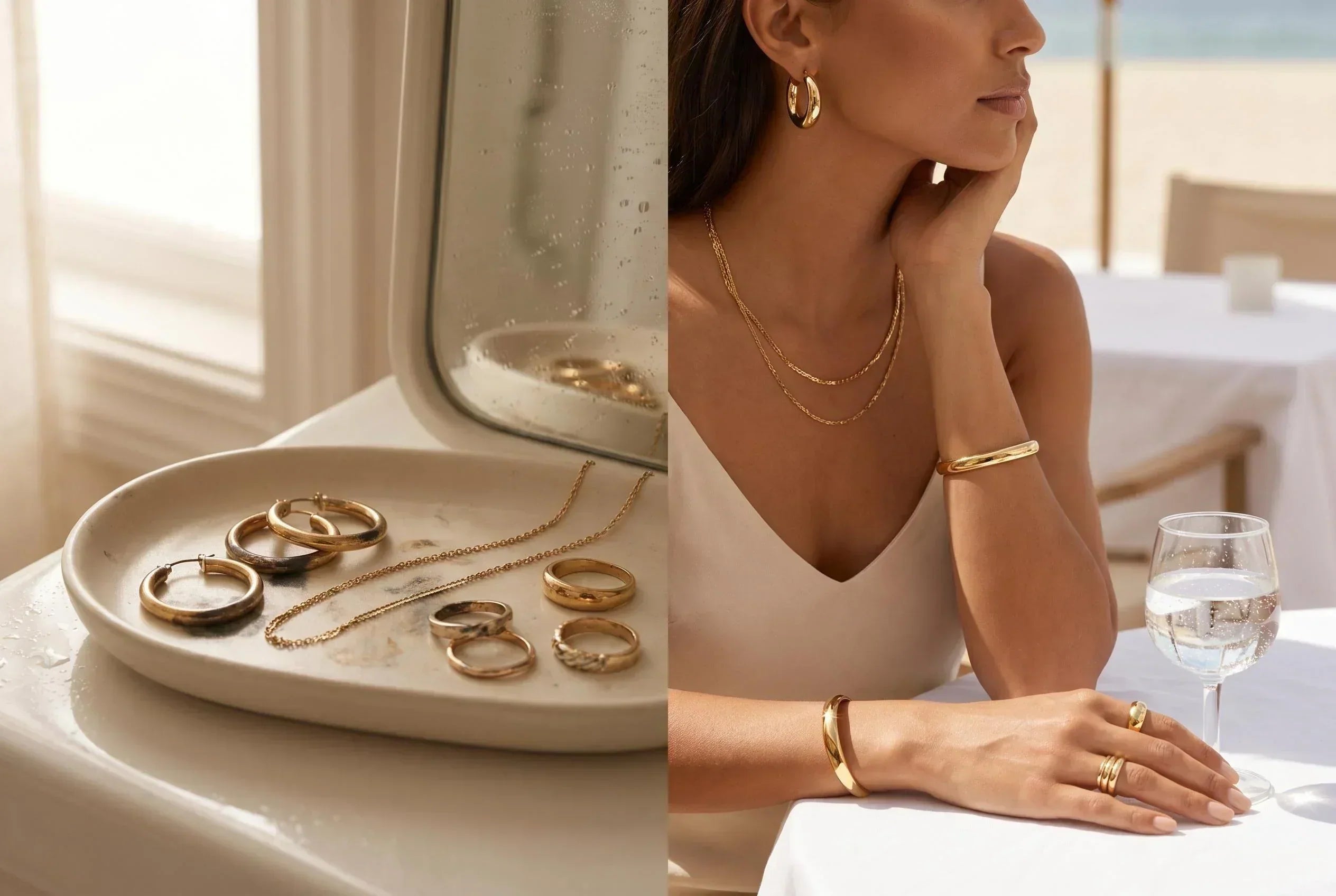
An honest answer to a common question Australian buyers ask about 18K PVD gold plated jewellery, and why the answer matters less than most people think.
The short answer is yes. The gold on 18K PVD gold plated jewellery is real 18K gold. Not gold coloured paint, not a fake finish, not a cheap trick. Real gold, applied in a specific way. But the better question, and the one worth a few minutes of your time, is what that actually means for what you are buying and what you should expect.
This is probably the single most asked question from Australian buyers considering 18K PVD gold plated jewellery for the first time. It usually comes with a tone of polite scepticism, like they already suspect the answer might be a marketing dodge. It is not. Here is what real gold means in the context of plated jewellery, where 18K PVD gold plated fits, and why quality 18K PVD gold plated is worth the money for the right buyer.
If you are brand new to how gold plating works, our 18K PVD gold plated guide covers the full picture of why plated is often the smart choice for everyday wear, and our PVD gold plating guide covers the technology side.
What Real Gold Actually Means
Gold in jewellery is measured in karats. Pure gold is 24K, which is 100 percent gold. Pure gold is also too soft to make jewellery from, so gold is always mixed with other metals to give it strength. The word gold in jewellery contexts therefore always refers to a gold alloy, meaning gold mixed with other metals in known proportions.
When a piece is described as 18K PVD gold plated, the 18K describes the gold used to create the plating layer. That gold is 75 percent pure gold alloyed with 25 percent other metals, typically copper and silver. The gold on the surface of your piece is genuinely 18K gold, by any reasonable definition and by the strict requirements of Australian Consumer Law.
Common Myths vs What Is Actually True
18K PVD gold plated jewellery is not real gold, it is just gold coloured.
The gold layer on 18K PVD gold plated jewellery is genuine 18K gold alloy. Gold coloured finishes use paint or dye and cannot legally be described as gold plated in Australia.
All gold plated jewellery is the same quality.
Quality varies enormously depending on the base metal used and the plating process. 18K PVD gold plating on 316L stainless steel is a premium tier. Electroplating on brass is a budget tier. Both can legally be called 18K gold plated.
Gold plated jewellery always wears off quickly.
Budget gold plated jewellery on brass often wears within a year. Quality 18K PVD gold plated jewellery on stainless steel holds its finish for several years of regular wear because the gold is bonded molecularly rather than deposited chemically.
You cannot tell the difference between solid gold and gold plated on your body.
Visually, quality 18K PVD gold plated jewellery looks the same as 18K solid gold to the naked eye. The difference is in weight and long term behaviour, not in the appearance of the gold itself.
What You Are Actually Paying For
When you spend $70 AUD on a quality pair of 18K PVD gold plated hoop earrings, you are paying for several things stacked together. Understanding what each layer of value represents makes it easier to judge whether any given piece is priced fairly.
The base metal
For quality pieces, this is 316L surgical grade stainless steel. The same material used in surgical instruments and implants. Non reactive, nickel free in quality pieces, does not oxidise, and provides a stable foundation for the gold plating. Cheap pieces use brass or zinc alloy here, which is why they tarnish and can leave green marks when the plating wears thin.
The gold itself
Real 18K gold, bonded to the surface. The amount of gold on a piece of plated jewellery is small, typically 0.2 to 0.5 microns of thickness, but it is genuine 18K gold. The cost contribution of the gold itself is a few dollars, but what matters is that it is present and real.
The plating process
PVD plating requires expensive vacuum chamber equipment and precisely controlled conditions. It costs significantly more to produce than standard electroplating, but produces a coating that is harder, denser, and more durable. This is where most of the cost difference between budget and quality plated jewellery comes from.
The design and production
The jewellery itself has to be designed, manufactured, polished and finished before it ever sees the plating chamber. Better designs, better finishing and tighter quality control all add to the cost and the value of the final piece.
The brand warranty and service
Quality brands stand behind their pieces with return policies, customer service and genuine care about the experience. That costs money to provide. Budget plated jewellery sold cheaply usually has no real support once the transaction is done.
A piece of 18K PVD gold plated jewellery on 316L stainless steel in the $50 to $150 AUD range for a quality brand is fair value for what you are getting. Anything drastically cheaper usually means the base metal, plating process, or both are budget tier. Anything drastically more expensive for a plated piece should be delivering something specific like notable design or oversized construction.
The gold is real. The question is what the gold is sitting on, how it was applied, and who is standing behind it.
Why Australian Consumer Law Matters Here
Under Australian Consumer Law, descriptions of jewellery must be accurate and not misleading. This applies at every level of the gold jewellery market, from high end fine jewellery down to the cheapest plated pieces. Specifically relevant for 18K PVD gold plated jewellery buyers.
If a piece is sold as 18K PVD gold plated, the plating must genuinely be 18K gold. A piece sold as 18K PVD gold plated using actually lower karat gold would breach consumer law. If a brand advertises PVD plating, the piece must actually be PVD plated. Electroplated pieces marketed as PVD would be misleading. If a brand claims stainless steel construction, the base must be stainless steel. Claims about water resistance, hypoallergenic properties, and durability must also be accurate and not misleading.
This is why transparency matters so much when you are shopping. Quality brands specify exactly what their pieces are made of, what process was used, and what performance to expect. Brands that are vague about these details usually have a reason.
From the Effortless Luxury Collection. 18K PVD gold plated on 316L stainless steel across every piece.


How to Verify You Are Getting Real 18K PVD Gold Plated
Once you decide to buy, these five checks separate genuine quality from marketing fluff. They apply whether you are shopping a local Australian brand online or comparing international options.
Quality pieces explicitly state 18K PVD gold plated on 316L stainless steel or equivalent specific wording. Vague phrases like gold plated finish or gold tone often indicate lower tier pieces. If the wording is ambiguous, ask directly before buying.
The base should be stainless steel, specifically 316L or surgical grade. If the listing says brass, zinc alloy or does not specify, that is a lower tier product. Brass bases can still be described as 18K gold plated legally, but they are not in the same quality category.
PVD, Physical Vapour Deposition, or vacuum deposited all indicate the premium plating method. If only gold plated is mentioned with no process named, the piece is typically electroplated. Both are real 18K gold, but PVD lasts significantly longer in everyday wear.
Quality 18K PVD gold plated pieces on stainless steel typically state they are waterproof, water resistant, hypoallergenic or nickel free. These claims must be accurate under Australian Consumer Law, so brands that make them usually stand behind them. Pieces that avoid these claims often cannot support them.
The real test of 18K PVD gold plated jewellery is how it looks after 6 to 12 months of actual wear. Reviews from customers who have owned the piece long term tell you far more than day one impressions. Look for mentions of beach wear, gym use, and daily wearing patterns.
Every piece at GLISTIA uses 18K PVD gold plating on 316L surgical grade stainless steel, and these details are stated on every product page. You can see the specifications clearly across earrings, necklaces, rings, wristwear and anklets. Transparency is the standard we hold ourselves to because it is what Australian buyers deserve.
Why This Matters More Than the Real Gold Question
Here is the point most buyers miss. Whether 18K PVD gold plated jewellery is real gold is settled. Yes, the gold is real. The more important question is whether the specific piece you are considering is well made, built with quality materials, and likely to hold up in everyday wear.
A piece of 18K gold plated jewellery on brass with electroplating might technically contain real 18K gold but will probably disappoint you within a year. A piece of 18K PVD gold plated jewellery on 316L stainless steel contains the same real 18K gold but behaves completely differently. Same technical description. Very different actual product.
This is why we keep coming back to the combination of PVD plating plus stainless steel base as the quality benchmark. It is what separates 18K PVD gold plated jewellery that is worth buying from budget 18K gold plated jewellery that is not, regardless of the fact that both contain real gold.
Yes. The plating on 18K PVD gold plated jewellery is genuine 18K gold, which is 75 percent pure gold alloyed with other metals. What 18K PVD gold plated means is that the piece has real 18K gold applied as a surface layer through a vacuum deposition process, bonded to a base metal underneath. The gold you see is real gold, it is simply applied as a coating rather than being the material of the whole piece.
The gold layer on 18K PVD gold plated jewellery is typically 0.2 to 0.5 microns thick, which is a very thin layer by weight but a substantial layer for a plating. The gold content by weight is small, usually a fraction of a percent of the total piece. What matters more than the raw quantity is the quality of the bond. PVD plating bonds the gold at a molecular level, which is why it holds up under wear far better than thicker but chemically deposited electroplating.
Generally no. The 750 and 18K stamps are reserved for solid gold jewellery in most international markets, indicating the piece is 18K gold throughout. Gold plated pieces are typically stamped with abbreviations like GP, GEP, or similar marks, or carry no karat stamp at all. The absence of a karat stamp on a plated piece is not a quality concern, it is simply how plated jewellery is typically labelled.
Generally no. The gold content by weight is too small to be worth recovering, and the market for used plated jewellery is limited. This is one of the key differences between plated and solid gold. If retaining resale value is important to you, solid gold is the right category. If you want beautiful jewellery to actually wear without worrying about its resale market, plated is the category. Most buyers fit the second description.
Because the material costs are completely different. A solid 18K gold ring contains the full weight of the piece in gold alloy, which at current prices is several hundred to several thousand dollars just in raw material. A PVD gold plated ring contains a tiny fraction of that in gold, with the rest being stainless steel. You are paying for the gold you actually have, the base metal underneath, the quality process used, and the finished product. The price difference reflects the real material difference.
Not as a monetary investment, no. 18K PVD gold plated jewellery does not hold resale value and is not purchased for its gold content alone. It is a good investment as a daily wear piece. You get the look of real gold, extended durability compared to budget plated, everyday practicality that solid gold cannot match, and significantly lower cost. For most Australian buyers, these practical advantages matter more than long term monetary value.
18K Gold Plated You Can Actually Wear
18K PVD gold plating on 316L surgical grade stainless steel. Waterproof, nickel free, made for Australian life.