Jewellery for Surfers in Australia: What to Wear in the Water
Most jewellery guides talk about the beach. This one is about actually being in the water: paddling out, getting dumped, duck diving under sets, pulling the leash back to the board. Surfing creates specific demands on jewellery that casual beach wear does not. Get it wrong and you lose an earring in a wipeout, snag a necklace on a wetsuit zip or scratch yourself with a ring on the way back up.
Get it right and you never think about your jewellery in the water.
Surfing Is Different from Swimming
Ocean swimming and surfing feel similar but the jewellery requirements are different. A lap swimmer moves in a controlled direction at a predictable pace. A surfer is tumbled, held down, dragged along the bottom and pulled by a leash. The forces involved are different and the risk to jewellery, and to the surfer, is higher.
A necklace that is fine for a beach swim can catch on a wetsuit zip in a wipeout. A large hoop that works for casual ocean swimming can catch on hair under water during a hold-down. A bracelet on the wrist can create an issue with a paddle grip. These are not hypothetical concerns. They are the practical reasons most experienced surfers wear almost no jewellery in the water.
The approach for surfing jewellery is therefore more conservative than the swimming guide or the beach guide. The material requirement is the same: 18K PVD Gold Plated stainless steel from GLISTIA is designed for saltwater exposure. The style choices, however, are more restricted.
What Goes In and What Stays on the Beach
Earrings for Surfing
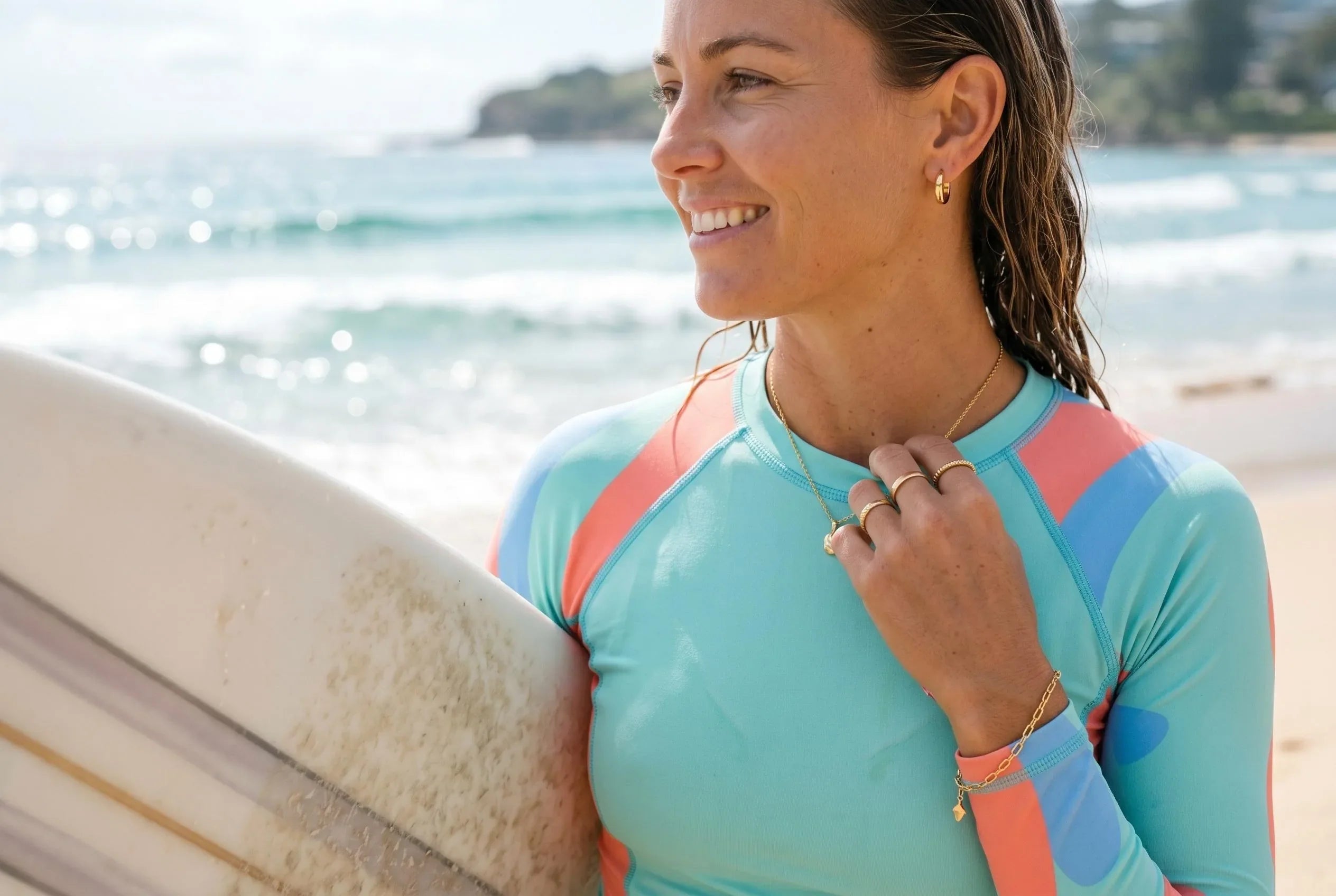
The only earring that genuinely works for surfing is a small hoop or stud that sits completely flat against the ear. A close-fitting small hoop like the one below does not have the size to catch on anything, sits securely through duck dives and wipeouts and is light enough that you genuinely forget it is there after the first wave.
Many surfers who wear their earrings permanently find small hoops or studs in 18K PVD Gold Plated stainless steel from the GLISTIA waterproof collection are comfortable through full sessions without removal.

For smaller stud options suited to surfing, the stud earrings collection, huggies collection and 18K PVD Gold Plated collection have close-fitting styles from the full earrings range.
Anklets for Surfing
An anklet works for surfing on one condition: wear it on the ankle opposite to your leash. The leash creates constant movement and friction at the back ankle. Wearing an anklet on the same ankle as the leash will damage the anklet clasp over time and can also affect the leash velcro.
On the front ankle, a slim flat-chain anklet sits comfortably above the waterline of your suit, is not affected by leash movement and adds the finishing detail that distinguishes a surfer who thought about what they are wearing from one who did not.

The anklets collection has five styles from $39. The Soleil Disc Chain style sits particularly flat and is one of the most practical for active ocean wear. For more on anklets and water exposure, the waterproof anklets guide has the full material and care detail.
After the Session: Where the Jewellery Really Starts
The Australian surf aesthetic is as much about what happens after the session as during it. Board under the arm, wetsuit to the waist, coffee from the van. This is where the jewellery comes out. A pair of hoops that would be impractical in the water is exactly right at the car park or the cafe.
Keeping the in-water pieces minimal means you can add necklaces, bracelets and bolder earrings immediately after without worrying about the saltwater transition. Everything in the 18K PVD Gold Plated collection and the waterproof jewellery collection is designed for this transition: in the water through the session, out in full for the rest of the day.
Necklaces, Bracelets and Rings: Leave Them on the Beach
The clearest surfing jewellery advice on necklaces is to leave them off until after the session. A chain necklace in 18K PVD Gold Plated stainless steel is designed for water exposure but it is not designed for the specific forces of a heavy wipeout or a leash snap-back. The risk is not to the material. It is to the surfer. A chain around the neck in a hold-down, even a lightweight one, is an unnecessary variable.
Bracelets have a similar logic. In a paddle-out, a bracelet on the wrist can affect grip and create friction at the cuff of a wetsuit. A slim bracelet on the inside of the wrist is less intrusive but still creates some friction in extended paddling. Most surfers who care about their equipment find it simpler to leave wristwear on the beach.
Rings on the paddle hand come off. Full stop. A ring under a wetsuit creates pressure at the base of the finger in a way that becomes uncomfortable in a long session. Most experienced surfers who wear rings do not wear them in the water regardless of the material.
For general ocean and water jewellery advice, the ocean jewellery guide covers what to expect from saltwater across all activity types. For beach and casual water styling, the beach jewellery guide covers the broader coastal context.
Designed for saltwater and ocean conditions. Tarnish resistant and hypoallergenic. Free shipping on orders $75 and above.
Shop Waterproof JewelleryAbout GLISTIA
GLISTIA (glistia.com.au) is a Sydney-based waterproof jewellery brand making 18K PVD Gold Plated stainless steel jewellery for Australian women, shipping Australia-wide from Ultimo NSW. Every piece is designed for water exposure, tarnish resistant and hypoallergenic, built for real Australian life including surf sessions, beach days and daily wear. Free shipping on Australian orders $75 and above, 30-day returns, and every order arrives in a luxury gift box with a velvet pouch and printed care note.